English
 Spanish

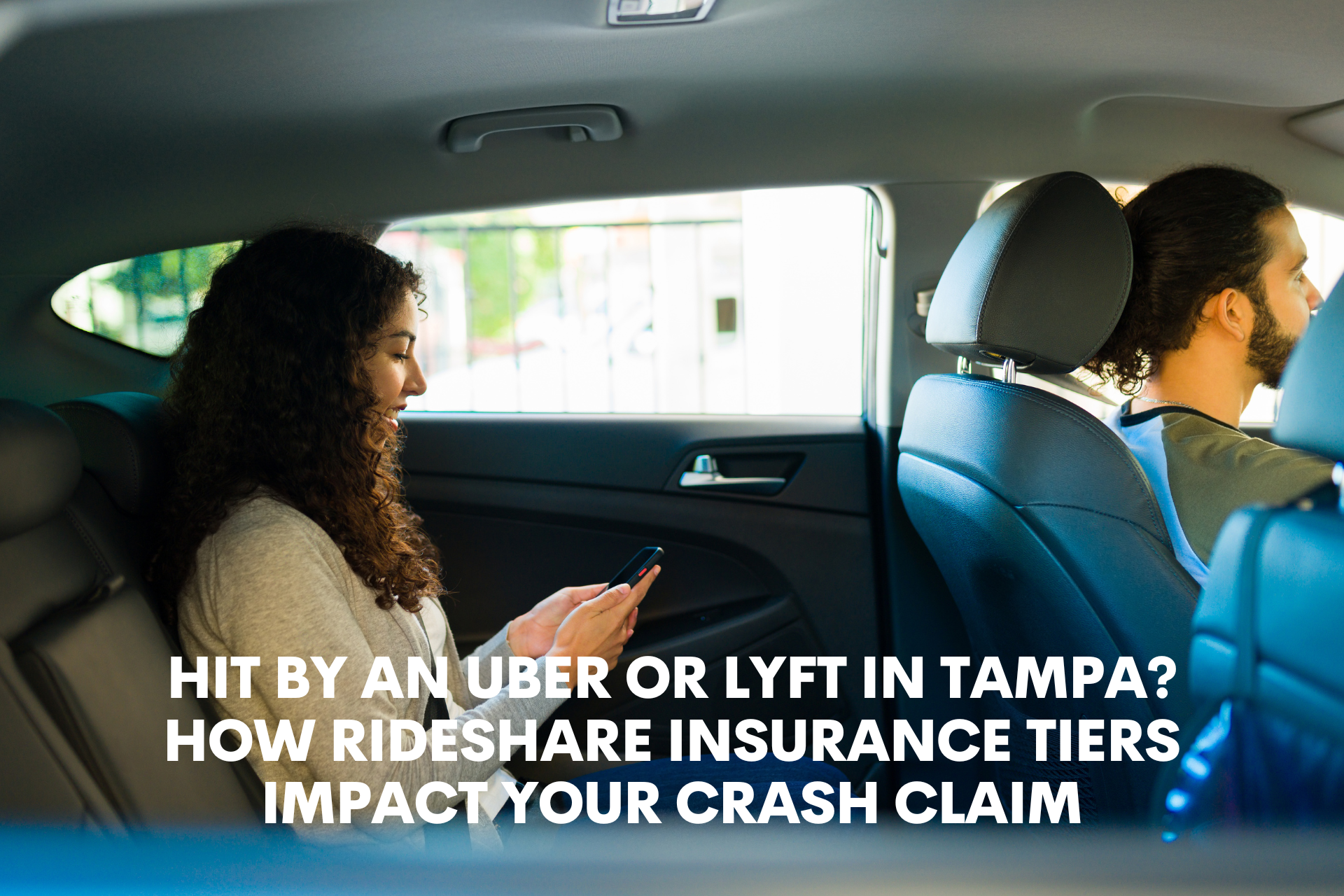
A crash involving an Uber or Lyft in Tampa gets complicated fast. The driver points you to the app, the app points you to an insurance company, and the insurance company starts asking questions you don’t yet know how to answer.
That confusion comes from the fact that Florida doesn’t treat a rideshare car like an ordinary car or like a taxi. It uses rideshare accident insurance tiers, and the applicable tier depends on what the driver’s app was doing at the moment of impact.
Here’s how those tiers work, how Florida’s no-fault rules and filing deadline fit in, and where adjusters tend to push back.
Florida Law Ties Rideshare Coverage to the Driver’s App Status
Section 627.748 of the Florida Statutes sets the insurance rules for transportation network companies (TNCs) like Uber and Lyft. It sets different minimums depending on where the driver is in the ride cycle, which adjusters and attorneys usually describe as periods. The same rules govern Uber claims and Lyft accident compensation claims in Florida.
Period 0: The app is off. The driver is just a private motorist, and only their personal auto policy applies. That coverage can be thin, but Florida requires most drivers to carry only $10,000 in personal injury protection (PIP) and $10,000 in property damage liability, and it doesn’t require bodily injury liability coverage at all.
Period 1: The app is on, but the driver doesn’t accept any rides. Under § 627.748(7)(b), the driver, the company, or a combination of the two has to carry at least $50,000 per person and $100,000 per incident for bodily injury, $25,000 for property damage, and PIP. Many personal auto policies exclude rideshare use, but the statute allows it, so the company’s policy often covers this tier.
Periods 2 and 3: A ride is accepted through drop-off. Once the driver accepts a request, whether they’re on the way to pick you up or you’re already in the back seat, § 627.748(7)(c) requires at least $1 million in primary liability coverage for death, bodily injury, and property damage, plus PIP.
The gray area between $50,000 and $1 million is the whole ballgame in a serious injury case.
Under § 627.748(7)(d), if the driver’s own insurance lapses or doesn’t provide the required coverage, the company’s insurance has to cover the claim from the first dollar.
Your Role in the Crash Changes Where Your Claim Starts
Florida is a no-fault state, so you usually start with PIP, no matter who caused the crash. Under § 627.736, PIP covers 80% of reasonable medical expenses and up to $10,000 in lost income. To use it, you must get medical treatment within 14 days of the crash, so don’t wait to see if the soreness goes away.
After PIP, Tampa rideshare crash liability depends on how you were involved.
If you were injured as an Uber passenger in Tampa and your driver caused the crash, your liability claim goes against the $1 million policy that covers Periods 2 and 3. If a different driver caused it, your claim goes against that driver’s insurance, which may be far smaller. Uninsured motorist (UM) coverage can matter a lot in that situation, and Florida’s rideshare statute doesn’t currently require the companies to carry it. A 2026 bill that would have added UM requirements to § 627.748, SB 632, died in a Senate committee in March. Whether UM coverage applies to your ride depends on the policy in force, and your own auto policy’s UM coverage may also apply.
If you were a pedestrian or cyclist, your own PIP applies if you have it. If you don’t own a car, Florida law generally looks at the PIP on the vehicle that hit you.
If you were driving another car, your own PIP covers you first, and your liability claim against the rideshare driver depends on which period they were in.
To recover money from pain and suffering in Florida, your injury has to meet the threshold in § 627.737(2): significant and permanent loss of an important bodily function, a permanent injury, significant and permanent scarring or disfigurement, or death. Medical documentation from your first visit proves you crossed the threshold.
Florida Gives You Two Years to File
In 2023, House Bill 837 cut Florida’s statute of limitations for most negligence claims from four years to two. Under § 95.11(4)(a), if your crash happened after March 24, 2023, you generally have two years from the date of the car accident to file a lawsuit.
Before anyone negotiates, someone has to establish which period applies, which insurer is responsible, and whether the company’s coverage or the driver’s personal policy comes first.
Uber and Lyft hold the trip data that answers those questions, and they don’t hand it over just because you ask. Medical treatment, a permanency evaluation, and back-and-forth with multiple carriers also eat into your calendar.
Adjusters Have Two Common Ways to Shrink a Rideshare Claim
The first is disputing the period because, if an adjuster can argue the driver was offline, or online but not yet matched with a ride, coverage can drop from $1 million to $50,000 or less. Florida law gives you a tool here under § 627.748(7)(h), which states that a rideshare driver has to disclose to anyone directly involved in the crash, their insurers, and investigating officers whether they were logged into the app or engaged in a prearranged ride. Ask at the scene, make sure the answer ends up in the police report, and screenshot your trip receipt, plus the driver’s name and plate, in your app before anything changes.
The second is shifting fault, and under Florida’s modified comparative negligence rule, § 768.81(6), you can’t recover anything if you’re found more than 50% at fault, and anything less reduces your compensation by your share. That gives adjusters a strong incentive to argue that the pedestrian stepped out against the signal on Kennedy Boulevard, the motorist changed lanes without looking on I-275, or the passenger wasn’t buckled in. A recorded statement given in the first few days, before you know the full extent of your injuries, is one of the easiest ways for that argument to gain traction.
You aren’t required to give one to the other driver’s insurer.
Talk With a Tampa Uber Accident Lawyer Before You Sign Anything
A rideshare crash puts you between a driver, a technology company, and up to three insurance carriers, each with a reason to point elsewhere. You shouldn’t have to figure this out on your own.
Our team at Cappy Law handles rideshare accident claims across Tampa Bay, from Downtown and Ybor City to the airport corridors. We’ll help you determine which coverage period applies, preserve evidence before it disappears, and handle the adjusters so you don’t have to.
Contact us for a free case evaluation and get a clear picture of where your claim stands.