English
 Spanish

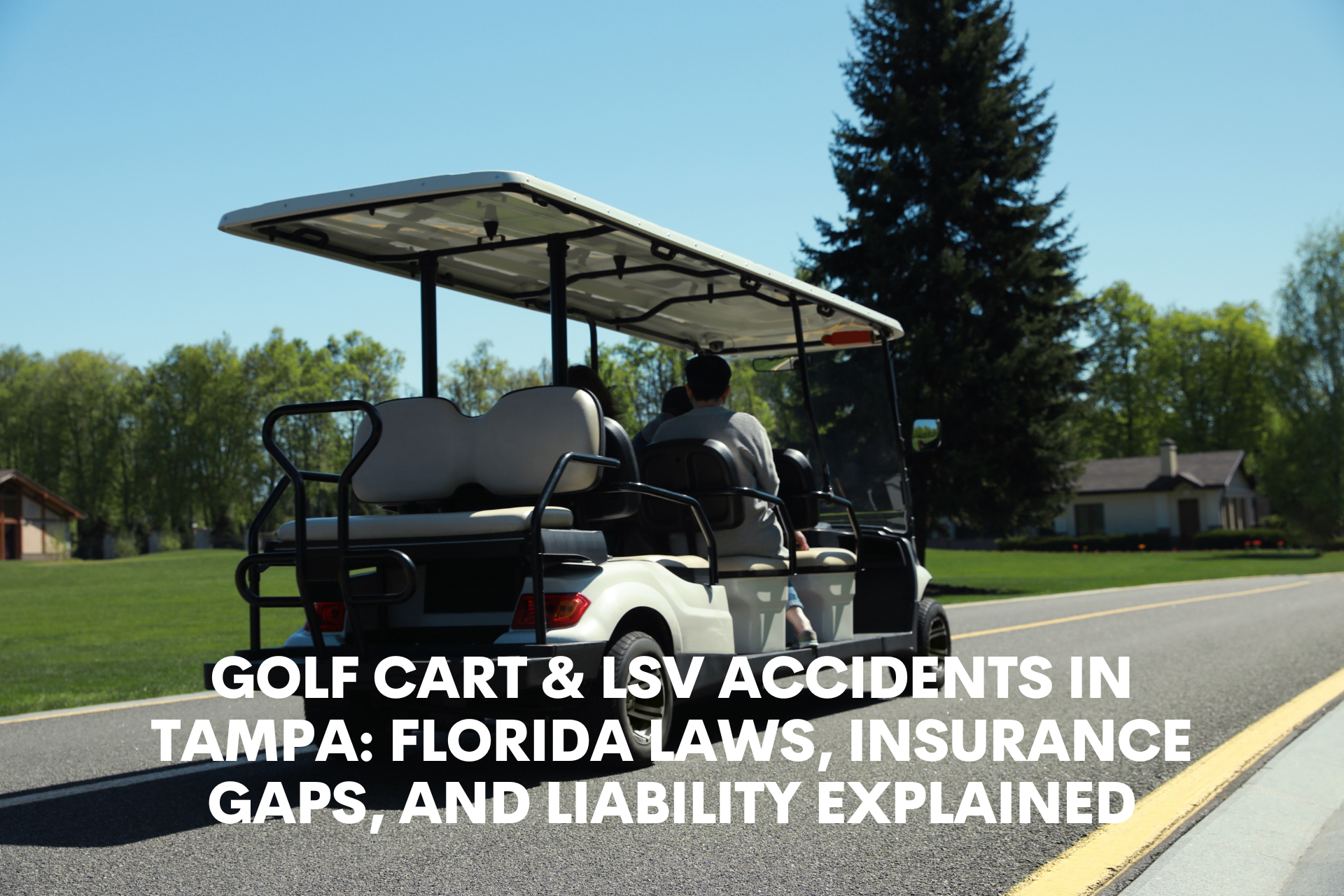
In Florida, a golf cart can get you to the park, marina, local coffee shop, or a pizza place on a Friday night without your car ever leaving your driveway.
It feels like a low-stakes move, which makes people let their guards down.
Golf carts have no doors, generally lack seat belts, and offer no way to absorb impact if an SUV pulls out of a driveway without looking. A study reported on every golf cart crash in The Villages from 2011 to 2019. It found 875 crashes, and in 27% of serious cases, someone was thrown from the cart.
Florida law treats these vehicles very differently from the ones kept in your garage, and your insurance policy does too.
Here’s how Florida law separates golf carts from Low-Speed Vehicles (LSVs), what changed for younger drivers, where insurance falls short, and who’s liable after a crash.
Golf Carts and LSVs Aren’t the Same Vehicle Under Florida Law
People generally refer to any vehicle that resembles a golf cart as a golf cart, but Florida law clearly distinguishes between two types of vehicles, and this distinction has a major impact on what happens after a collision. Under section 320.01(22) of the Florida Statutes, a golf cart is designed for use on a golf course and can’t go faster than 20 mph.
Section 316.212 specifies that it can only be used on public roads which have been specifically designated by your county or city for golf cart use, and only during daylight hours, unless your local government permits its use at night and the cart is equipped with headlights, brake lights, turn signals, and a windshield.
A low-speed vehicle, defined in section 320.01 as a four-wheeled vehicle with a top speed exceeding 20 mph but not more than 25 mph, has more freedom on the road.
Under section 316.2122, these vehicles may use any road with a speed limit of 35 mph or less. The LSV must be titled, registered, and insured, and the driver must have a valid driver’s license.
The many lifted, street-legal carts you see in Tampa are in fact registered LSVs. A standard cart modified to exceed 20 mph no longer qualifies as a golf cart under Florida law, which can create problems with registration, insurance, and determining fault after a low-speed vehicle accident.
Florida’s 2023 Law Changed Who Can Drive a Golf Cart
For years, a 14-year-old in Florida could drive a golf cart on a designated road without a license, and many parents in Tampa grew up with that rule. Nowadays, the neighborhood habits still show that even though the law changed in 2023.
House Bill 949 (Chapter 2023-67, Laws of Florida) amended section 316.212(7), effective October 1, 2023, so that anyone under 18 now needs a valid learner’s license or driver’s license to drive a golf cart on a public road. Drivers 18 and older need a valid government-issued photo ID. Because Florida doesn’t issue a learner’s license before age 15, a 14-year-old can’t legally drive a cart on any public street anymore, including the one in front of your house.
If your unlicensed teen is behind the wheel when a crash happens, that violation follows the claim. An insurance company may point to it when deciding who’s at fault and how much it’ll pay, and the cart’s owner, usually a parent, can end up at the center of the case.
Your Auto Policy Probably Doesn’t Cover Your Golf Cart
In Tampa, the amount of insurance coverage for a golf cart is almost completely determined by the type of vehicle you have and what your policies say, and that’s where most owners get caught off guard. An LSV has to carry the same minimum level of coverage as cars, which includes $10,000 for Personal Injury Protection (PIP) and $10,000 for Property Damage Liability (PDL).
PIP pays for your own injuries, and PDL covers damage to someone else’s property,but neither one covers injuries you cause to another person, and Florida doesn’t require bodily injury liability coverage. That means an owner of an LSV is left with only the state minimum and has no protection if they seriously injure a pedestrian, a cyclist, or a passenger in another cart.
Traditional golf carts have the opposite problem, since Florida doesn’t require any insurance on them. Auto policies usually exclude them, and homeowners coverage typically applies only on your own property or a golf course, so a crash on a neighborhood street may leave you with no coverage.
A standalone golf cart policy or an endorsement that covers on-road use fills in what your other policies miss.
You should also check whether your uninsured motorist (UM) coverage protects you as a cart occupant if an uninsured driver hits you, and read the full policy, not just the summary page.
Liability Can Reach Beyond the Person Behind the Wheel
Like any crash, LSV accident liability starts with negligence, whether someone rolls through a stop sign, turns without checking for a cart, drives distracted, or drives impaired. Florida’s DUI statute, section 316.193, applies to golf cart and LSV drivers just like anyone else.
Florida’s dangerous instrumentality doctrine can also make a vehicle’s owner liable when someone they’ve allowed to use it causes a crash. In Meister v. Fisher (1984), the Florida Supreme Court held that a golf cart counts as a dangerous instrumentality, so if you hand your keys to a neighbor’s kid or your own teenager, you may share responsibility for what happens next.
Under the modified comparative fault rule in section 768.81, which took effect with House Bill 837 in March 2023, you can’t recover damages if you’re found more than 50% at fault.
At 50% or less, your recovery drops by your percentage. Insurers know this, and they’ll look for anything that shifts blame toward you, including an unlicensed driver, a cart on a non-designated road, or an LSV on a street posted above 35 mph.
For most negligence claims arising after March 24, 2023, section 95.11 gives you two years to file a lawsuit. That window closes faster than most people expect, especially while you’re recovering.
Talk to a Tampa Golf Cart Accident Lawyer Before You Talk to the Insurer
If you or a family member was hurt, our team at Cappy Law can help you understand where you stand. We’ll look at how the crash happened, which policies apply, and what your claim is realistically worth, so you can make decisions with clear information instead of an adjuster’s version of events. Schedule your free case evaluation.